

In His Last Movie, John Wayne Refused To Dishonor His Western Character
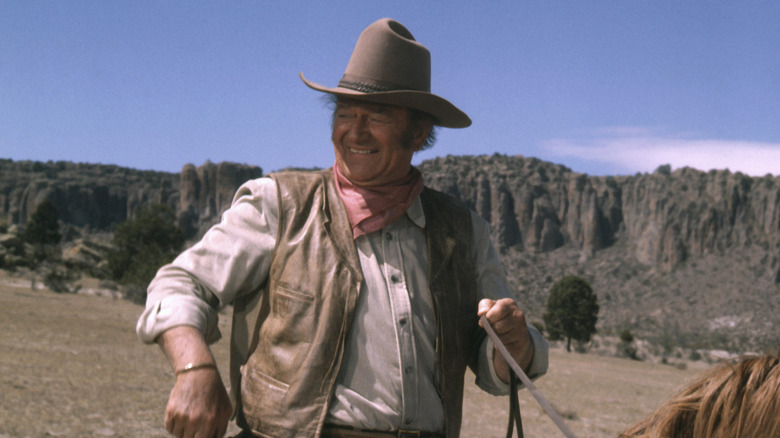
John Wayne remains one of the biggest icons of the Western genre, so it's no surprise that right 'til his very last role, he was a stickler for its conventions. In fact, in one interview, Clint Eastwood shared a story about Wayne being asked to skirt one of those conventions, and being so angry about it he turned blue.
While Wayne worked outside the Western genre on occasion, there's no debating that it was his niche, so it makes sense that he had strong opinions on what he believed should and shouldn't be in those movies. Fast-forward to his final role, in 1976's "The Shootist." The Don Siegel film was meant to end with Wayne's character shooting his adversary in the back before being shot in the back himself. However, Wayne raised an objection. As Clint Eastwood recounted in an appearance on "The Actor's Studio," Wayne told Siegel, point-blank (geddit?), no. "[Siegel] said there was a long pause, and he said John Wayne said, 'You mean, I shoot him in the back?'" Eastwood shared (via YouTube). Siegel confirmed that was the case, to which Wayne reportedly replied, 'I don't shoot anyone in the back.'" Eastwood didn't specifically mention Wayne's stance on things like graphic violence, but at the time, he was talking about the at-times ridiculous conventions in Westerns to keep the hero honorable (like waiting for an adversary to draw a gun before shooting), so it's clear that was what he was getting at.
Back to the conversation between Siegel and Wayne, Eastwood added that the former had gone on to make "a terrible error" by telling Wayne that Eastwood would have had no problem shooting someone in the back. Unsurprisingly, that didn't go down well. Eastwood joked that after briefly turning blue, Wayne reiterated that he would. Well, he certainly stuck to his (morally positioned) guns!
John Wayne wasn't Clint Eastwood's biggest fan
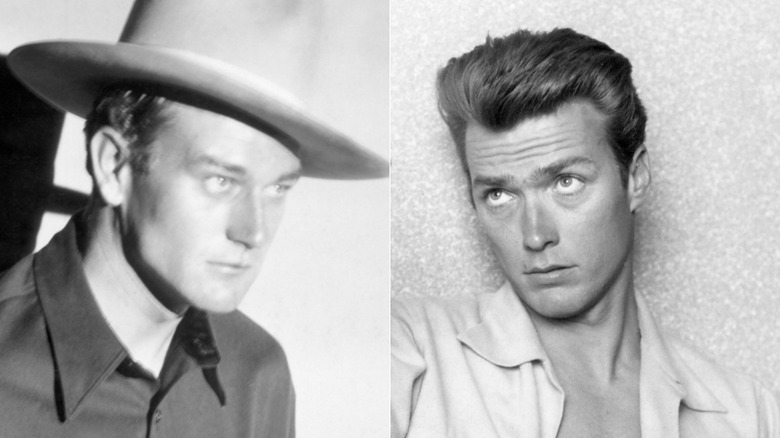
Comparing one actor to another is never a great move, but when those actors happen to have a relationship as rocky as John Wayne and Clint Eastwood's was, we'll agree with the assessment that Don Siegel "made a terrible error." Moreover, it's worth noting that one of the reasons for that rockiness was because Eastwood was willing to challenge the conventions of Western films.
In the early '70s, Eastwood had actually tried to work with Wayne on a film called "The Hostiles," which would have seen their characters go from rivals to partners. We won't get into all the details here, as the film ended up only being made decades later in 2009 – in part because Wayne wouldn't do it. As noted in "John Wayne: The Life and Legend," Wayne's first rejection had been cordial enough, the actor sending the script back to Eastwood with the note, "No, thanks." However, that hadn't spelled it out enough for Eastwood, and after he sent the script to him once more, Wayne got down to it. Part of the reason for not being interested, he said, was because of a decision Eastwood had made as the director of "High Plains Drifter." According to Wayne, Eastwood's characterization of the townspeople had been unfair and inaccurate, and the pioneers should have been depicted with more respect.
In fairness, Wayne's unwillingness to work on the film wasn't because of what he saw as shadiness from Eastwood in his past work or even that he couldn't stand him, but "The Hostiles" script itself. That much became obvious when Wayne's son sent him the script, and he not only refused to do it, but threw it off his yacht, scoffing, "This piece of s*** again." Wayne was consistent, that's for sure.