

The Stunning Transformation Of Tim McGraw
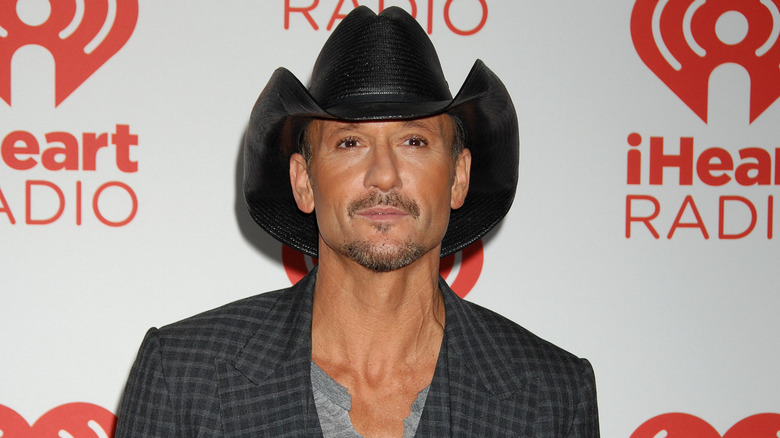
Tim McGraw occupies a singularly unique position in show business. On one hand, he's a massively successful country music artist who's sold a staggering 90 million albums over the course of a career spanning four decades, earning 46 No. 1 singles and 19 No. 1 albums. In fact, he's set a still-unbroken record as the country artist to receive the most radio play. He's also a reliable concert draw — his 2024 Standing Room Only tour lived up to its name, with the singer's shows frequently selling out.
That would be enough for anyone's résumé, yet that only represents one facet of McGraw's talents. Beyond music, he's also become a familiar face to film and television viewers, having starred in multiple movies and a wildly popular TV series.
Since entering public consciousness in the early 1990s, he's taken both Nashville and Hollywood by storm, and fans get the sense that he's just getting started — one heck of a journey, and it's far from over. To find out more, read on for a look back at the stunning transformation of Tim McGraw.
Tim McGraw was 11 before he learned he was the son of MLB pitcher Tug McGraw
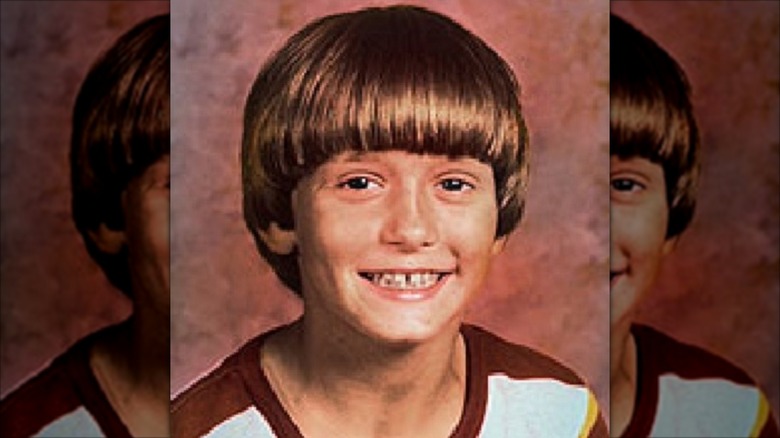
When delving into the untold truth of Tim McGraw, the story begins with his mother, Betty Trimble. She was just a teenager when she lost her virginity to a minor league baseball player and became pregnant. When the athlete left town to join the majors, Tug McGraw, who went on to a 19-year career in Major League Baseball as a relief pitcher with the New York Mets and the Philadelphia Phillies, she welcomed her baby alone.
Yet until he was 11, young Tim McGraw believed that his stepfather, Horace Smith, was his dad. "I was going through the closet looking for Christmas presents. I ran across my birth certificate. That's how I found out," McGraw said during an appearance on "Larry King Live" (via CNN), revealing he'd once had his father's baseball card pinned to his bedroom wall.
He called his mother at work, and she immediately rushed home and revealed the truth, that his birth father was the baseball legend, not the man believed to be his dad. She called the baseball star and explained that Tim had found out, and father and son finally met face to face, a meeting that he remembers as being "awkward." "I was 11 years old. I was a kid. I think it was more traumatic for everybody around me than it was for me."
Tug McGraw denied being Tim's father for years until they developed a relationship
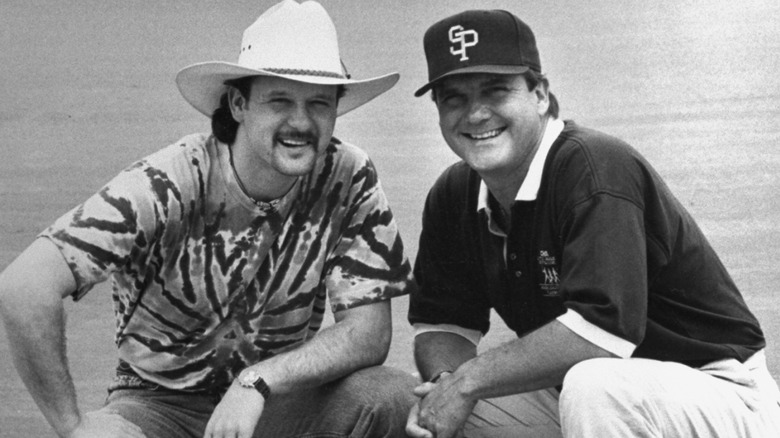
During Tim McGraw's initial meeting with Tug McGraw, his father didn't exactly embrace the idea that he was Tim's father. "We had a lunch and he goes, 'We can be friends, but I don't know if I'm your dad or not,'" McGraw told NPR. The following year, the lad traveled to Houston to watch Tug play and tried to contact him after the game. It did not go well. "And I remember going over and walking and standing right in front him and yelling "Hey Tug!' ... and he ignored me the whole time, and that was the last time I saw him [until I was 18]," McGraw recalled.
In 1985, after Tug retired from baseball, McGraw's mother got in touch with Tug's lawyer and demanded he pay her $350,000 in back child support. That got his attention, and a settlement was reached that would see the athlete pay $42,000 for the 18-year-old's college education and take a paternity test proving he was the father, but with one stipulation: Tim could never contact him again. Before Tim would sign off on that deal, he wanted to meet Tug one more time.
When they finally met, and Tug saw that Tim had grown into his spitting image, he declared a paternity test wasn't necessary, and both agreed to leave the past behind and try to forge a relationship with each other. They did and remained close until Tug's 2004 death at age 59.
A pawn shop guitar changed his life
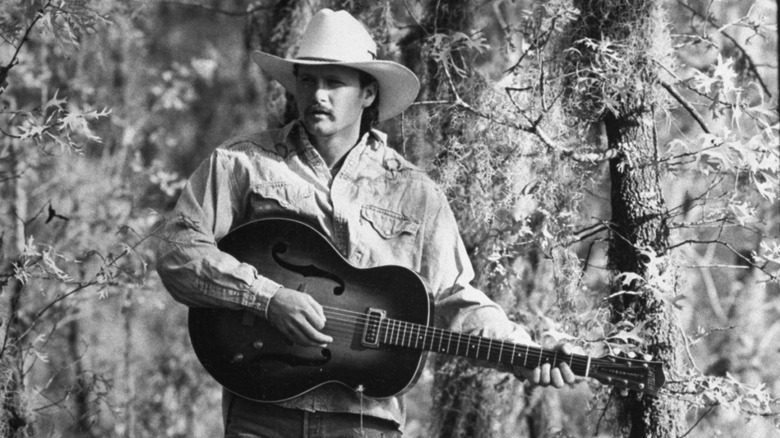
As a musician, Tim McGraw's origin story began shortly after he began attending Northeastern Louisiana University on a baseball scholarship. "I pawned my high school ring my freshman year of college and bought a guitar for 20 bucks," he explained in a video he posted to Instagram. "Spent the whole summer, learned about 50 or 60 songs on the guitar ... and that was my repertoire," he continued, revealing he accompanied himself on that guitar, sans band, while performing those songs at a local joint. "I played there for tips for, gosh, for six months," he recalled.
At that point, music was a hobby; ever since watching Al Pacino in the movie "And Justice for All," McGraw had set his sights on becoming a lawyer. "I was going to go to law school, and that was going to be the trajectory I was going to take in life," McGraw said in an interview with CBC Radio's "Q."
As he continued performing, what had begun as a fun pastime became his primary focus, while those dreams of law school began feeling less important. "So the law career started slowly drifting away," he recalled. It was at that point he made a bold decision that changed everything.
He dropped out of college to pursue a career in music
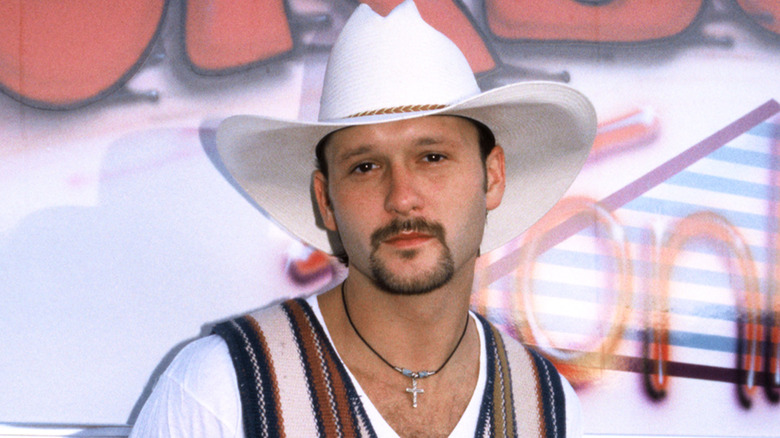
Tim McGraw was two-and-a-half years into college when he decided to sell his possessions and move to Nashville in order to seriously pursue a career in country music. First, however, he needed to share that new plan with his mother. "And so I was scared to death to call her and tell her I was going to drop out of college," he told NPR.
Dreading the conversation, McGraw picked up the phone and dropped his bombshell. Her response, however, shocked him. "And there was silence on the line," McGraw continued. "And of course, I expected, 'Hell, no, you're not!' but what I got back from my mom was, 'Well, I'm surprised you haven't done that already.' And she said, 'You need to go do it, otherwise you'll always wonder if you could have made it.'"
With his mom's blessing, McGraw packed up the meager possessions he had left and moved to Music City. It was a decision he has never regretted.
His first album tanked, but his second hit big
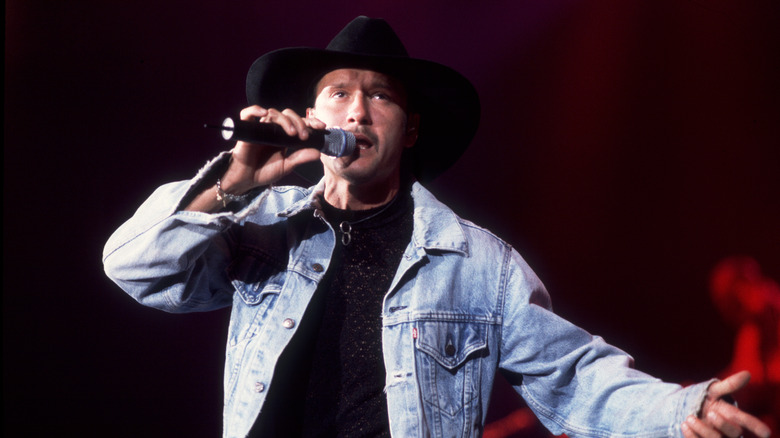
While in Nashville, Tim McGraw began writing songs and put together a demo recording. As a favor, his father, Tug McGraw, passed that demo along to Mike Borchetta at Curb Records ... and nothing happened. So, the singer called Borchetta, week after week, with no response. Finally, he became so frustrated that he simply showed up and barged into Borchetta's office and pleaded with him. "I talked him into listening to the tape," McGraw said when interviewed on "Larry King Live." "Signed me a couple weeks later."
McGraw's self-titled debut album was released in 1992, along with a single, "What Room Was the Holiday In?" The single went nowhere, but its follow-up, "Welcome to the Club," performed better, remaining on the country charts for 15 weeks, peaking at No. 47.
It was the release of his second album, 1994's "Not a Moment Too Soon," that proved to be a game-changer. The album's first single, "Indian Outlaw," managed to irk Native American organizations while also becoming a major hit, with protests leading some radio stations to ban it. Despite the controversy, McGraw had arrived, with that album yielding a string of hit singles, including "Don't Take the Girl," "Down on the Farm," and "Refried Dreams." His subsequent albums continued building on that success, cementing him as a force to be reckoned with in Nashville.
Touring with Faith Hill led to one of country music's most successful marriages
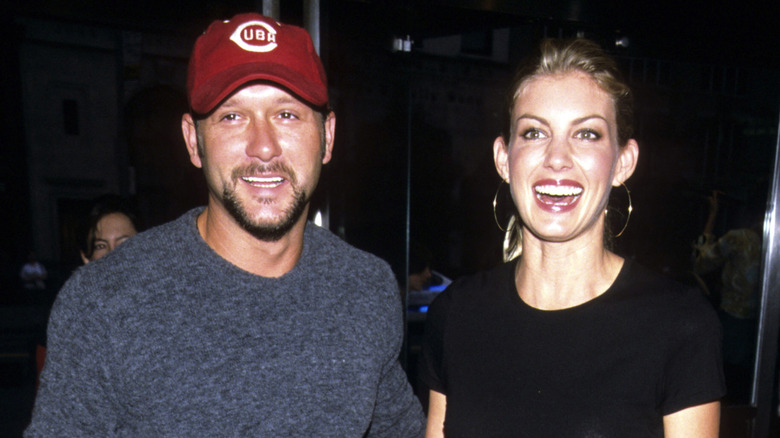
Tim McGraw is a firm believer in love at first sight — because it happened to him with Faith Hill. "I knew instantly," he told NPR. "I knew the first time I saw a picture of her that I was in love." As for how McGraw and Hill met, that took place when Hill was booked to be his opening act for his Spontaneous Combustion tour in 1996. Suffice it to say, the music wasn't the only thing combusting during that tour, and sparks flew both onstage and off as they got to know each other.
The attraction was obvious to both, but there were some hurdles. "She was in a relationship. I was just getting out of my relationship," McGraw recalled. As the tour progressed, however, he finally made a big move, storming into her dressing room and kissing her. That could have easily gone south, but that kiss wound up having the desired effect. "And by the end of the tour," he added, "we were married."
Tying the knot in October 1996, the newlyweds wasted little time before starting a family, welcoming daughter Gracie, the first of their three children, all daughters, in May 1997. "I had a very dysfunctional childhood," McGraw told Billboard of their haste. "So I wanted what I didn't have: a stable family."
He launched a successful parallel career as an actor
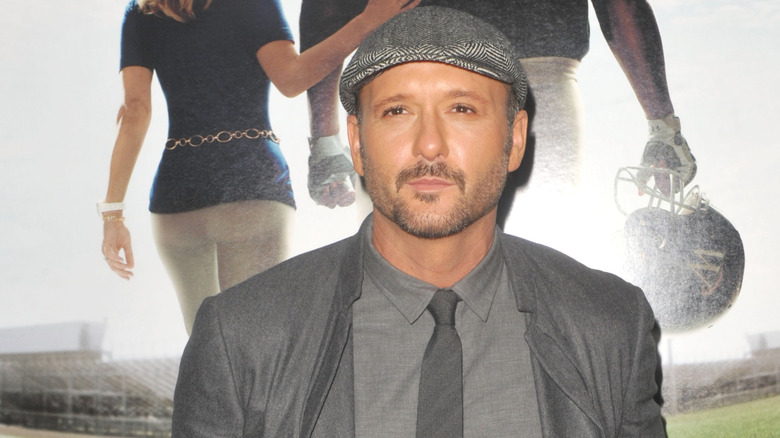
In 1997, Tim McGraw made his acting debut when he guest-starred in an episode of a TV sitcom, "The Jeff Foxworthy Show." It wasn't until a few years later, however, that McGraw began to take acting seriously. In 2004, he was seen portraying a sheriff in the indie film "Black Cloud," and later that same year as the abusive father of a high school football star in "Friday Night Lights."
Appearing on "TL's Road House," McGraw recalled how the "Friday Night Lights" script spoke to him. "I grew up in athletics around coaches and bad dads and all the stuff around the field," he said. "When I read the script, I was like, 'I know that guy.'" When he expressed interest in the role, however, he learned it had already been cast. Undeterred, McGraw tracked down director Peter Berg in Texas, where filming was about to begin, and delivered an impromptu audition. A few days later, he received a phone call from the film's star, Billy Bob Thornton. "'I just heard from Pete Berg, and he said some country singer just came in and blew him away,'" Thornton told McGraw. "It looks like you got the gig."
After that, McGraw continued a parallel career as an actor. Other films have included "Flicka," "The Blind Side," "Four Christmases," "Country Strong," and "Tomorrowland." And while McGraw enjoys acting and has gotten pretty good at it, he'll never quit his day job. "I'll always be a singer," he told The Boot. "That's what I do."
He racked up a string of hits during the 2000s
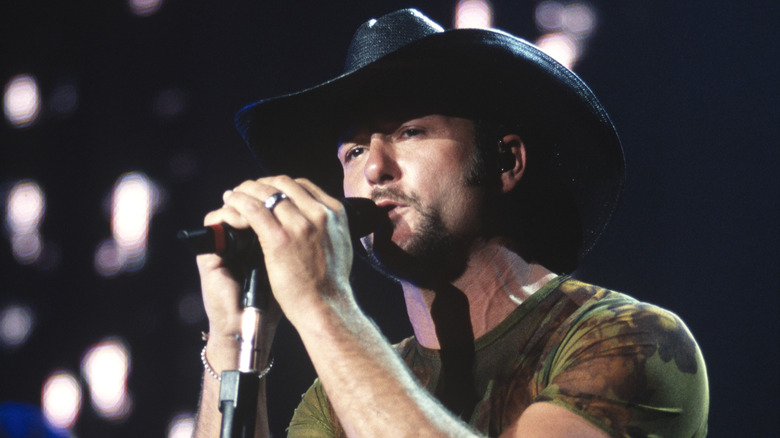
At the same time that Tim McGraw began dipping his toe into the acting world, his music career was on fire. He released five albums during the course of the 2000s, building on the success of his 1999 smash, the triple-platinum "A Place in the Sun." He also recorded a duet with his wife, Faith Hill, "Let's Make Love," which won him his first Grammy.
Then came 2001's "Set This Circus Down," which hit No. 1 on the country charts, and No. 2 in the pop charts, spawning four No. 1 singles, while his 2002 duet with Jo Dee Messina, "Bring on the Rain," also hit No. 1. That winning streak continued; he became so ubiquitous in the country world that 16-year-old phenom Taylor Swift wrote a song about him, 2006's "Tim McGraw." "I remember when it first came out, I thought, gosh, have I gotten that old that somebody's writing a song about me?" McGraw recalled during an appearance on Australian TV show "The Project." "But then someone told me she's 16 and wrote it in math class, so I felt a little bit better about it after that."
As the 2010s dawned, McGraw attempted to branch out his sound with a more pop-friendly direction with "Lookin' for that Girl," which included some autotune, and which his fans roundly rejected. McGraw responded by going back to his roots, replacing autotune with steel guitar for an old-school country sound of "Meanwhile Back at Mama's" and "Shotgun Rider," both of which hit No. 1.
He changed his lifestyle, shed 40 lbs, and got ripped
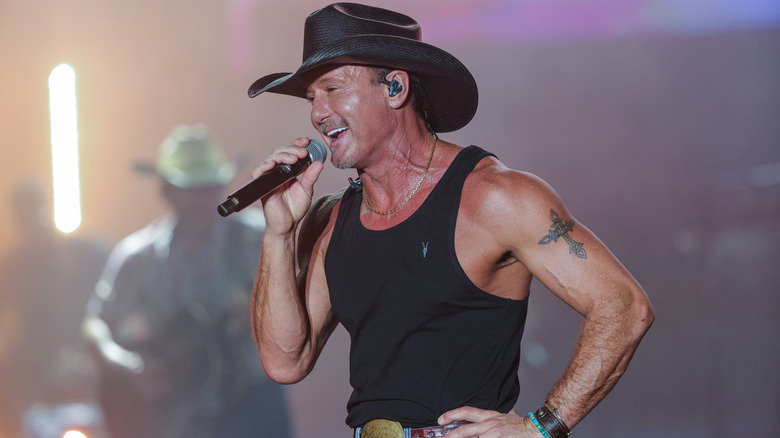
Tim McGraw had always enjoyed a drink or two. Drinking, he explained in an interview with People, had been a coping mechanism to overcome his inherent shyness. "Basically, I am an unsure, self-conscious, shy person. That is how I started — even when I was in college, before I would get on stage, I would start drinking," he explained.
By 2008, however, his imbibing had accelerated to the point that friends were beginning to worry. He realized he needed to take control. "I felt like I had to change it," he said. "I felt like I had to change my life." He quit alcohol and substituted exercise for drinking, leading to the stunning transformation of McGraw's abs.
He kept at it, approaching his workouts with the same passion he put into his music and acting. As a result, McGraw was in the best shape of his life in his 50s. "I don't really get tired of training," he told Men's Health. "There's such a feeling of accomplishment that comes from the feeling of being my age and still being at the top of my game."
He signed a lucrative record deal with Big Machine
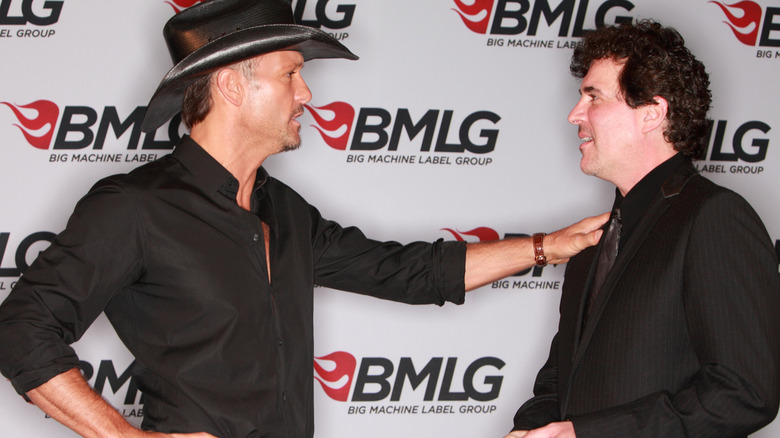
In the midst of those decades of success, Tim McGraw had grown frustrated with his label, Curb Records. In 2012, he left his longtime label and signed with Scott Borchetta's Big Machine, the record label that wound up selling her Taylor Swift's masters without her consent to music manager Scooter Braun, demonstrating his shady side. For McGraw, the move represented continuity, as it was Borchetta's dad, Mike, who'd originally signed him to Curb. It also resulted in a flurry of lawsuits, with Curb claiming that McGraw had breached his contract by delivering his final album for the label ahead of schedule, while McGraw countersued (via The Hollywood Reporter), accusing the label of placing him in a state of "involuntary servitude."
Curb then upped the ante by claiming that most of the songs on his debut album for Big Machine, "Two Lanes of Freedom," had been recorded while he was still under contract to Curb, and sued him over claims that Curb owned the copyright to those master tapes. A judge eventually sided with McGraw.
"We're very pleased that the District Court has dismissed Curb Records' lawsuit against Tim McGraw and Big Machine Records," Borchetta said in a statement, via Taste of Country, taking a thinly veiled shot at Curb. "Our No. 1 goal and intention at the Big Machine Label Group is to sign great artists with great vision and do everything in our power to create an environment for them to do their best work."
He starred alongside wife Faith Hill in a Yellowstone prequel
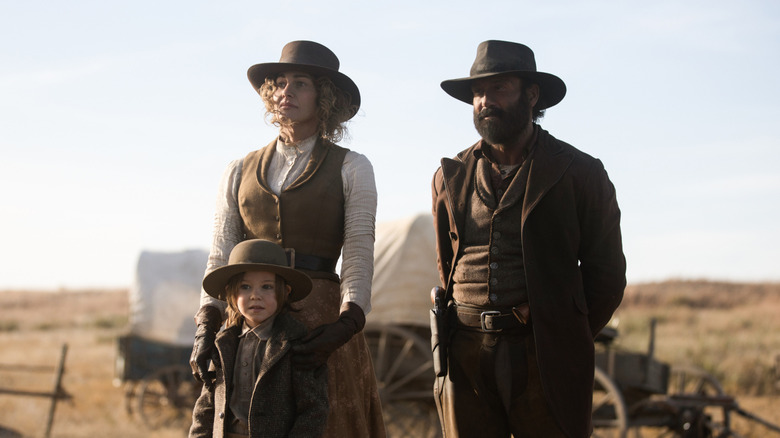
Among the odd facts about Faith Hill and Tim McGraw's marriage is just how much they enjoy working together. That typically manifested in recording songs together or singing duets onstage, but in 2021, they took that to a whole other level when they co-starred in a television series. In "1883," a prequel to mega-hit "Yellowstone" set in the Old West, the couple portrayed James and Margaret Dutton, great-grandparents of the character played by Kevin Costner in the original series. "This is truly a dream job," said McGraw in a statement to The Hollywood Reporter. "The Duttons are tremendous characters and it's so thrilling to be able to bring them to life."
McGraw decided to take a Method-acting approach to his "1883" role — to the point that he avoided showering. "She's like, 'I don't care about Method. You stink!'" he told Variety of his wife's take on his acting approach.
The role also led McGraw to another physical transformation, packing on some extra weight and growing a big, bushy beard. "When I grow my beard out, it's completely white," he explained. "So the hardest part was keeping that thing dyed. So showing up and doing a [concert] and having this big old beard on, and I'd put on like 10 pounds during the filming of the show, just to look more like the part."
Tim McGraw returned to the stage after taking a year off to recover from several surgeries
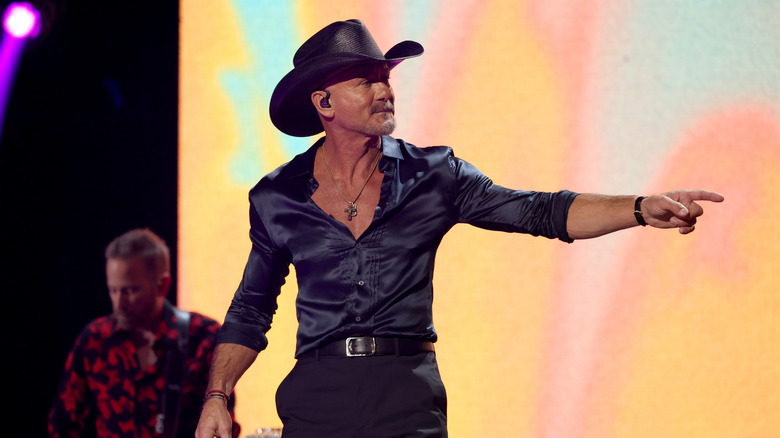
Unbeknownst to his fans, in the years after "1883," both Tim McGraw and wife Faith Hill had endured some serious health struggles. In 2024, in the midst of his Standing Room Only Tour, he suffered an injury that required major surgery, with McGraw undergoing a double knee replacement. He was forced to cancel the remaining dates on the tour, and also pulled out of a Netflix drama, set in the world of bull-riding, that he'd agreed to star in.
In October 2025, McGraw returned to the stage for the first time since his surgeries, revealing he'd hit a rough patch. "I've had four back surgeries and double knee replacements, just in the last couple of years," McGraw told the audience at a show in Highland, California, reported Fox News. "And my wife has been going through quite a bit of surgeries — she's had five neck surgeries, and she's had a couple of hand surgeries," he continued, revealing Hill's surgeon was in the audience.
As McGraw continued, he revealed that he'd become so despondent over the health woes that he gave serious thought to giving up his career as an entertainer. "I didn't want to," he said, "but I didn't think it was going to get better." Over time, however, he began to heal, and both his body and mind improved. "But it's gotten better," he added.