

Jonah Hill Has One Of The Worst Cases Of 'Ozempic Face' After Weight Loss

Plenty of Hollywood stars have admitted to taking the popular prescription drug Ozempic and other similar drugs to fast-track their weight loss, including award-winning actor Kathy Bates and media mogul Oprah Winfrey. So far, that list hasn't included Jonah Hill, who has attributed his dramatic weight loss to lifestyle changes rather than medication. In 2012, when asked how he managed to lose over 40 pounds from his reported peak weight of 280, Hill told "Nightline" host Bill Weir (via ABC News), "It was just mostly diet. I wish there was some crazy thing that I did, like a pill or a genie or something, but it was, unfortunately." But that was before his recent extreme weight loss.
These days, Hill has lost even more weight to the point of looking almost unrecognizable in paparazzi pics and film set photos. He even has one of the worst cases of the so-called "Ozempic face" despite not being publicly known to be on the prescription drug — at least as of this writing. After photos surfaced of Hill looking shockingly gaunt on the set of his film "Cut Off" in January 2026, many accused the actor of falling victim to the Ozempic face trend that has swept through Hollywood. "Jonah Hill has Ozempic'd himself into Diane Keaton," one user joked on X, formerly Twitter. "I think I'll stay fat, thanks."
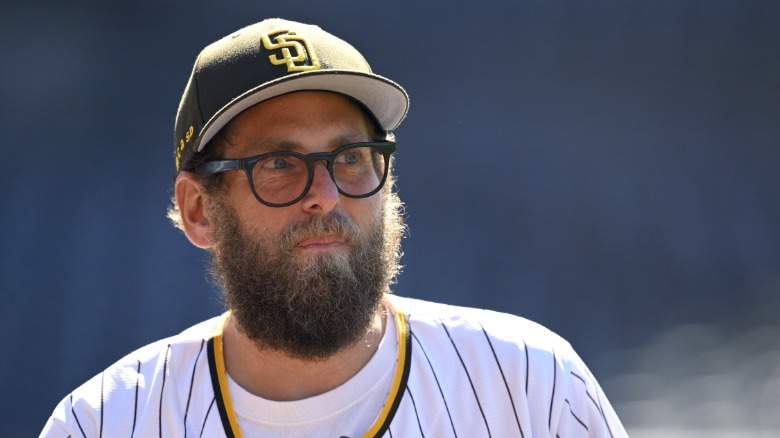 Orlando Ramirez/Getty
"GLP-1 drugs can reduce not only deeper facial fat, which provides youthful volume, but also a special layer under the skin called white adipose tissue (WAT). This tissue contains stem cells that produce growth factors, cytokines, and hormones essential for skin health," plastic surgeon Dr. Samuel Golpanian explained to Nicki Swift. Once that layer decreases, "It affects both the skin's structure and its ability to rejuvenate," he added, causing that hollowed, sunken look commonly associated with Ozempic use.
Jonah Hill has always struggled with his weight
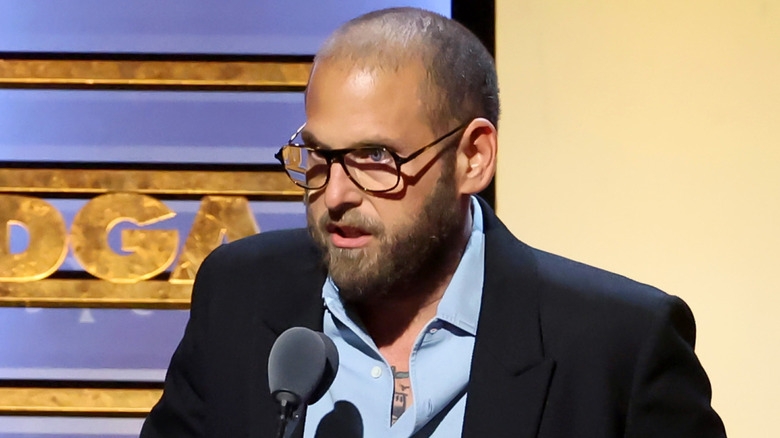
It's no secret that Jonah Hill has significantly struggled with his weight and body image since he was young. "When I was a kid, exercise and diet was framed to me as like, 'There's something wrong with how you look.' But never once was exercise and diet propositioned to me in terms of mental health," he recalls in his documentary film "Stutz" in 2022 (via People). His insecurities only grew worse when he started acting in 2004 and became known as the fat, funny guy in films "Superbad" and "21 Jump Street." For years, he was the subject of relentless body-shaming in interviews and headlines, which admittedly took a toll on his mental health. "It made me so defensive ... [and] angry," Hill 'fessed. "It kept me from feeling any sense of [being] able to grow past negative feelings about myself.'"
Sometime around 2011, Hill decided to finally take his health seriously and lose weight for his movie "Moneyball," which would earn him an Oscar nomination for best supporting actor as the strategist Peter Brand. He was able to lose over 40 pounds through regular exercise and diet (including doing 100 push-ups daily), only to regain most of it back for his 2016 film "War Dogs." His weight continued to fluctuate in the years that followed, and it wasn't until his mid-30s that the actor found a sustainable approach to fitness with the help of jiu-jitsu and surfing.
To date, it's unclear whether or not Hill did hop on the Ozempic train in order to lose so much weight, but fans across social media sure have a lot to say about it. "Some people look better thick," one X user lamented, while another added, "He looks happy, good for him."