

Forgotten Feuds Of Hollywood's Golden Age Stars
We may receive a commission on purchases made from links.
We live in a society that is obsessed with celebrities, where fans follow the comings and goings of their favorite stars like moths to a flame, and the press exhibits a similar ferocity in its own coverage. In an era where entertainers' latest looks, legal entanglements, and ongoing projects are discussed ad nauseam on social media, it's the petty battles and feuds between them that manage to get the most ink. From Drake and Kendrick Lamar exchanging diss tracks to "Sex and the City" stars Sarah Jessica Parker and Kim Cattrall famously falling out, everyone loves a celebrity beef.
That said, this phenomenon isn't a new one. Long before the tabloids and Twitter battles of today, during Hollywood's golden age from the 1920s to the '60s, bruised egos and bitter rivalries regularly boiled over into on-set drama and long-term grudges. And while they weren't as widely reported as the viral moments that emerge between modern celebs, they could be just as brutal. With that in mind, here are some of the forgotten feuds from the era that first saw film and television gossip become a part of everyday life — back when celebs were still learning how to celeb.
Olivia de Havilland and Joan Fontaine had a sibling rivalry that lasted a lifetime
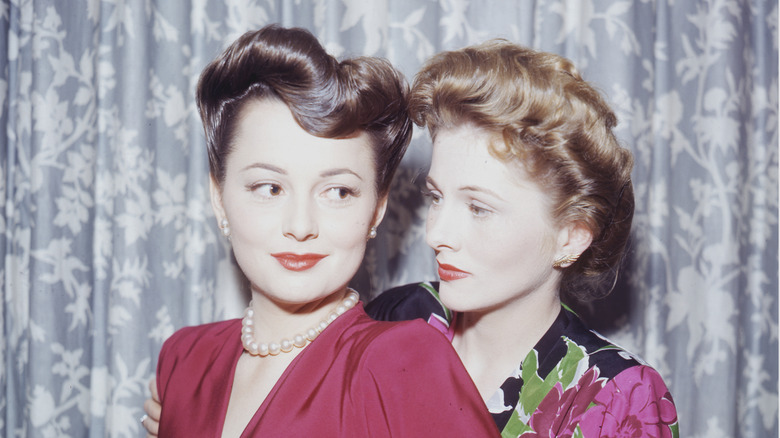
Olivia de Havilland and Joan Fontaine were two of the biggest actresses of Hollywood's Golden Age. Both garnered several Academy Awards nominations for Best Actress in a Leading Role, netting three statuettes between them; de Havilland won for "To Each His Own" and "The Heiress" in 1947 and 1950, respectively, while Fontaine took home the trophy in 1942 for "Suspicion." They also starred alongside some of the most iconic leading men of all time, actors like Cary Grant, Laurence Olivier, Errol Flynn, and others.
What modern moviegoers might not realize is that the two women were actually sisters and had a sibling rivalry that lasted a lifetime. For her part, Fontaine — who was a year younger than de Havilland — claimed that her sister bullied her from a young age. Per Vanity Fair, de Havilland once penned a mock will in school, in which she reportedly wrote something along the lines of, "I bequeath all my beauty to my younger sister, Joan, since she has none." Fontaine further alleged that de Havilland fractured her collarbone during a poolside altercation as a teenager.
The two reportedly continued to compete with each other through adolescence, early adulthood, and into their acting careers, which would see them pitted against each other — Fontaine's "Suspicion" Oscar came when de Havilland was also nominated for "Hold Back the Dawn," making for an awkward Oscar night. And for years after, reports of tense interactions and extended periods without talking were commonplace, with no definitive answer on whether the sisters reconciled before their deaths.
Frank Sinatra and Marlon Brando clashed while filming Guys and Dolls
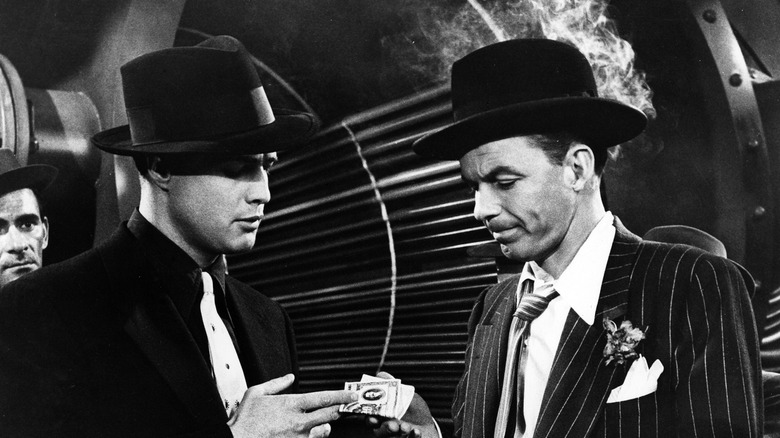
From the era spanning the early/mid-1950s to the early 1970s, few male performers had the cachet of Oscar-winning actor Marlon Brando and singer Frank Sinatra. So, when the two were working on the same set for the 1955 musical "Guys and Dolls," it was kind of a big deal. It was one of the top-earning films of its year and went on to net multiple Academy Award nominations and win a Golden Globe for Best Motion Picture/Musical or Comedy.
Behind the scenes, though, the Brando-Sinatra partnership was more like a collision of worlds than a joining of forces. As noted by Far Out Magazine, Sinatra was reportedly angry before the film started shooting due to Brando landing the lead role over him, despite having been offered the part previously. The two later had issues during production. Sinatra reportedly nicknamed Brando "Mumbles," and Brando got back at him by intentionally ruining takes during a scene in which Sinatra had to eat cheesecake, forcing him to eat more and more.
The feud reportedly reached an even higher pitch when Sinatra's estranged wife, Ava Gardner, spent time with Brando on set. Carlo Fiore, who was a friend of Brando's, later claimed that Brando was threatened with death and castration by "goons," who he believed were sent by Sinatra. "I'm sure Sinatra was behind this whole thing. He threatened and intimidated other people in his life ... Why not Marlon? His arch-enemy number one," Fiore said (via Daily Express).
Doris Day and Mamie Van Doren's tiff may have been sparked by jealousy
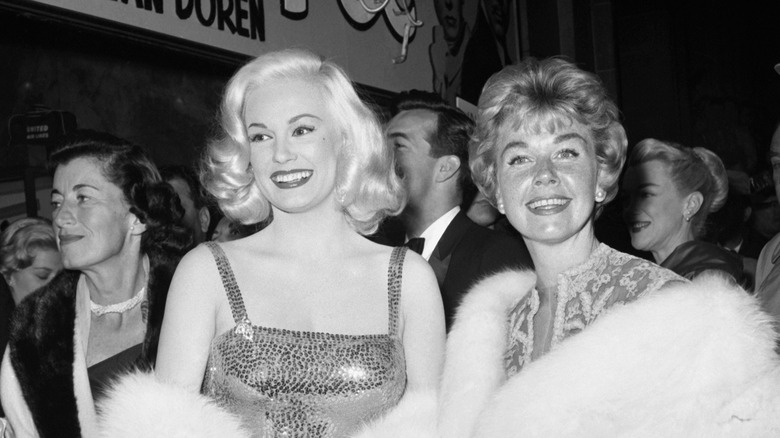
Hollywood legends Doris Day and Mamie Van Doren shared the screen in the 1958 proto-romcom "Teacher's Pet," which also starred Clark Gable. And while the film ultimately earned praise from contemporary critics, all was apparently not well between Day and Van Doren while the film was in production.
A 95-year-old Van Doren spoke to Closer in 2026, breaking down her experience working on the film. She enjoyed working with Gable, who she referred to during the interview as a "king" and "a complete professional," noting that the "Gone with the Wind" star helped her and even covered for her in scenes. However, she offered a drastically different take on her female co-star, telling the outlet: "Doris Day, on the other hand, didn't like me. Perhaps female jealousy of older star of young upstart. It was a disappointment to me, as I idolized her when I was growing up."
Those comments echoed the assessment Van Doren offered in her 1987 memoir, "Playing the Field," in which she wrote: "Doris ignored me when we were first introduced and proceeded to conduct herself like a spoiled star." Despite the cold reception and awkward shooting experience, Van Doren told Closer that she admired Day's work with animals and later did promotional work for her organization.
Bette Davis and Joan Crawford had one of the most bitter feuds of all time
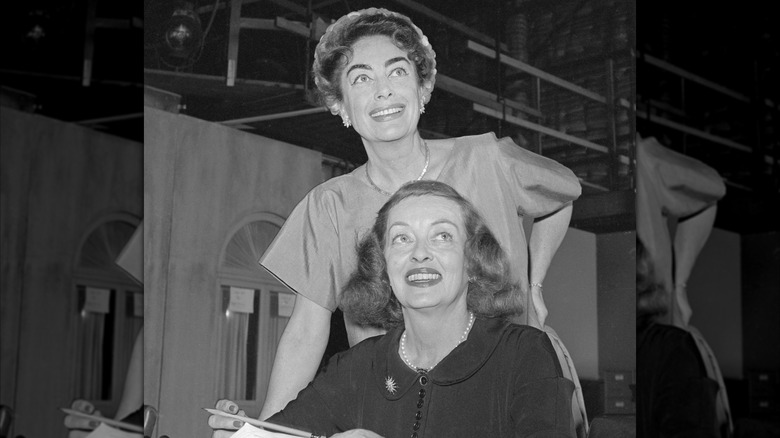
One of Hollywood's nastiest feuds of all time, the issues between Bette Davis and Joan Crawford dated back to 1933 when, as recounted by Harper's Bazaar, the former was set to see her name above the title on the marquee for the first time in the comedy film "Ex-Lady." However, in a cruel twist of fate, Crawford announced her divorce from her first husband, Douglas Fairbanks, Jr., on the same day. As a result, according to biographer David Bret, Davis' film was relegated to a brief mention in the New York Times, while the Crawford news received major coverage (and "Ex-Lady" ultimately faltered).
Two years later, real beef began to brew when Crawford married actor Franchot Tone, whom Davis had also developed feelings for. "She took him from me," Davis claimed in 1987 (via the Daily Mail). "She did it coldly, deliberately, and with complete ruthlessness. I have never forgiven her for that and never will."
Over the following decades, the feud between Davis and Crawford took myriad twists and turns. There were award show slights, rumors of Crawford being sexually attracted to Davis, Davis playing a washed-up actress seemingly based on Crawford in a movie, the two awkwardly sharing the screen on 1962's "What Ever Happened to Baby Jane?," and more.
Dean Martin and Jerry Lewis' legendary partnership turned sour
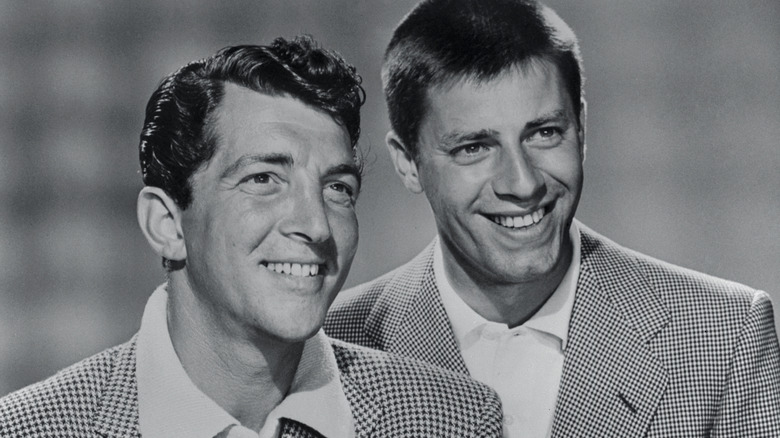
Although Rat Packer Dean Martin and comedian Jerry Lewis had incredible star power and legendary careers on their own, they also played an important role in one another's stories. After meeting in the early 1940s, the two formed the comedy duo Martin and Lewis, an act that saw them climb the show business ranks from nightclubs to radio and television series and, finally, the big screen. From 1949 to 1956, the duo appeared in 16 films together, including 1953's "Scared Stiff," and became A-listers in the process.
Despite their incredible success, Martin and Lewis ultimately went their separate ways in 1956 amid personal and professional strife. As noted by Far Out Magazine, Lewis recalled that while working on their final film, "Hollywood or Bust," together: "I wouldn't tell Dean what I thought of him, so [director] Frank Tashlin took all the flack." Meanwhile, Martin reportedly said that Lewis was "nothing to [him] but a f*****g dollar sign." It has also been alleged that Martin felt that Lewis was heavy-handed in driving their work. In the end, the two played a final show together at the Copacabana in 1956, but they went their separate ways and stopped speaking.
Thankfully, the story didn't end there. After years of press inquiry regarding a potential reunion, the two finally came together in 1976 when they embraced on-stage at an MDA Telethon. And while the reunion was awkward, they reportedly reconciled after Lewis attended the funeral of Dean Martin Jr.
Debbie Reynolds and Elizabeth Taylor in a legendary love triangle
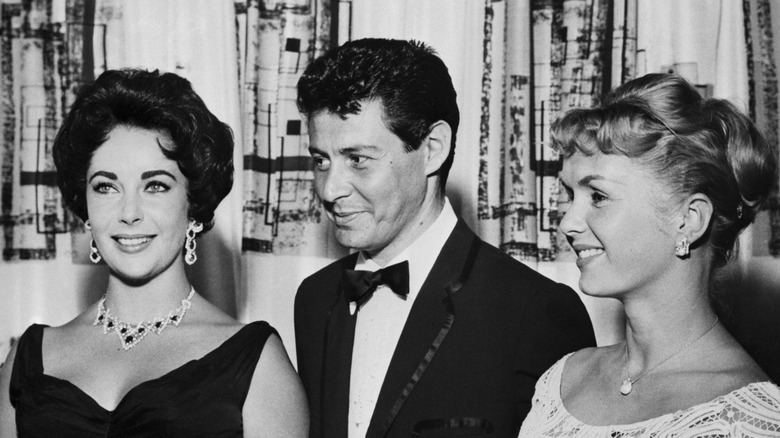
In a celeb-obsessed culture, few things generate interest like a star-studded love triangle. Again, though, such incidents aren't unique to the modern era of hot takes and 24/7 news. Romantic drama between stars dates back to Hollywood's Golden Age, when icons Debbie Reynolds and Elizabeth Taylor formed a legendary love triangle with Eddie Fisher.
Reynolds and Taylor began as friends and fellow actresses, with the former once recalling (via Vogue), "We went to school together on the [MGM] lot, when she was in between films. I was just a beginner, and she and I were not in any manner alike, but we got along very well." Years later, though, when both were A-list stars, radio silence ensued after Fisher, who had been married to Reynolds from 1955 to '59, divorced her and wed Taylor, with whom he'd struck up an affair following the death of her husband, Mike Todd.
Ultimately, Taylor and Fisher's marriage proved to be tumultuous, but the affair damaged the relationship between Reynolds and Taylor, too. The two former friends had a massive falling out, with Reynolds later remarking (via People), "We had a lapse of time when she took Eddie to live with her because she liked him, too. She liked him well enough to take him without an invitation." The two finally reconnected on a cruise in 1966 and worked on a movie together in 2001.
Orson Welles and William Randolph Hearst clashed over Citizen Kane
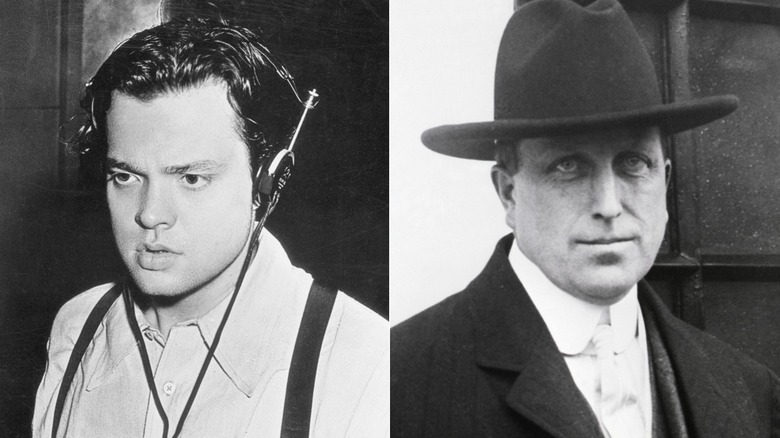
Arguably the ultimate auteur filmmaker, Orson Welles' work on the 1941 film "Citizen Kane" — which he co-wrote, directed, and starred in — remains one of the most highly lauded efforts in cinema history. But the film may never have come into being if not for media mogul William Randolph Hearst, whose life story provided the inspiration for Welles' lead character, Charles Foster Kane. Ironically, though, it was Hearst who nearly stopped the film from seeing the light of day.
As noted by The Guardian, citing research by Harlan Lebo for his book "Citizen Kane: A Filmmaker's Journey," Hearst allegedly engaged in a campaign to discredit Welles and bully RKO Pictures into shelving the project. The outlet noted that Welles never suspected Hearst of being directly involved in the effort, which was said to include the hiding of a 14-year-old girl in his hotel room along with two photographers to catch the actor with a scandal-making snap, and Hearst newspapers being banned from advertising the film.
According to Lebo, unearthed memos later showed that the Hearst organization worked to brand Welles a communist in the years preceding the Red Scare, and Hearst himself was likely aware of proceedings. "It's typically been assumed that Hearst probably didn't know about it and it was probably just his lackeys trying to protect the boss. But it's clear he knew about it the entire time," Lebo told The Guardian.
Shelley Winters and Frank Sinatra's dust-up on Meet Danny Wilson was legendary
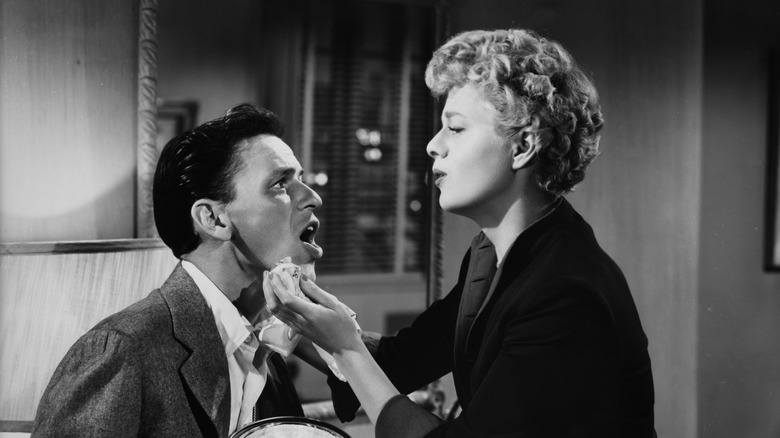
Marlon Brando wasn't the only Hollywood star who had difficulty working with Frank Sinatra on a movie. For her part, Shelley Winters — who won Academy Awards for Best Actress in a Supporting Role for her work in 1959's "The Diary of Anne Frank" and 1965's "A Patch of Blue" — tangled with Old Blue Eyes on the set of the 1952 musical "Meet Danny Wilson."
As recounted by Winters in her 1980 memoir, "Shelley: Also Known As Shirley," the shoot began in chaos due to Sinatra being in the process of divorcing Nancy Barbato (to get with Ava Gardner), and things only got worse from there. After getting along initially, the two reportedly got on each other's nerves fairly soon into production, with the clash coming to a head during a late-night shoot at the Burbank airport. Although Winters couldn't recall exactly what ignited the argument, things ended up getting physical.
"The mildest things we called each other were "bowlegged b***h of a Brooklyn blonde" and "skinny, no-talent stupid Hoboken bastard,"" she wrote of their dust-up. "At about three in the morning Frank flew into a terrible rage at me ... I screamed like a fishwife and I think I slugged him." What followed was a saga that involved the sending of angry telegrams, Winters refusing to attend a meeting with Sinatra, a bedpan being thrown during a hospital scene, production being temporarily shut down, and many more harsh words.
Sophia Loren's side-eyed glance at Jayne Mansfield became a pre-internet meme
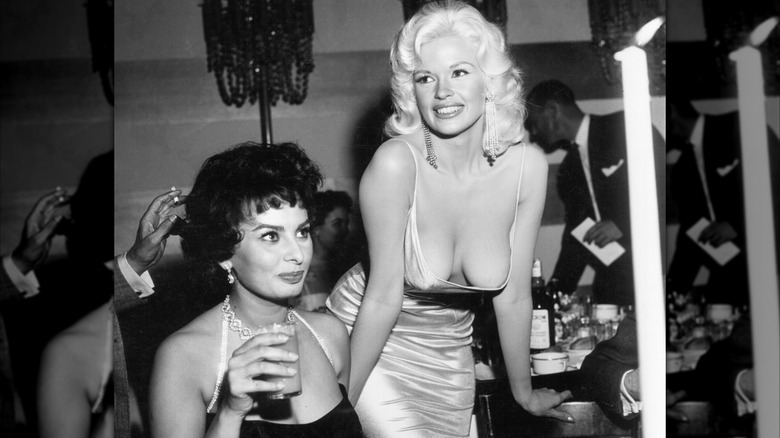
In the 2020s, GIFs and memes featuring images or clips from films, television, events, and more have become a form of shorthand. If the internet had been around in 1957, a now-infamous photo of Sophia Loren — who has often shared her thoughts on the secret of aging gracefully — giving Jayne Mansfield an epic side-eye might have been a go-to GIF for relaying loathing or disdain.
The photo was taken at Loren's "Welcome to Hollywood" party, thrown that April by Paramount Studios in honor of the Italian star's move to Tinseltown. As recounted by the BBC, citing Eve Golden's "Jayne Mansfield: The Girl Couldn't Help It," Mansfield was in attendance and was seemingly on a mission to steal the spotlight at the event. In what may have been a calculated move, Mansfield sat down next to Loren and stared directly into a camera lens for what would become one of Hollywood's most iconic snaps.
Years later, Loren explained that she was looking at Mansfield's low-cut dress, fearing a possible wardrobe malfunction, saying (via Entertainment Weekly), "Look at the picture. Where are my eyes? I'm staring at her nipples because I am afraid they are about to come onto my plate." That said, while other photos showed the two women laughing, Loren made it clear which photo captured her feelings on what Mansfield was doing: "There may be other photos, but this is the picture. This is the one that shows how it was. This is the only picture."
I Love Lucy's Fred and Ethel actually hated each other
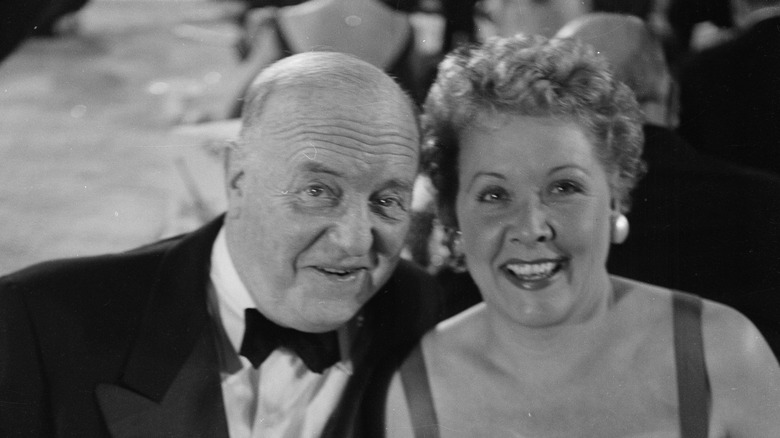
While they weren't the leads of the show, it's hard to argue that Fred and Ethel Mertz aren't one of the most iconic couples in sitcom history. Brought to the screen by William Frawley and Vivian Vance, Fred and Ethel were the friends and landlords of Lucille Ball and Desi Arnaz's Lucy and Ricky Ricardo in CBS' "I Love Lucy," and they played the part of the bickering but loyal couple to perfection. However, their off-screen dynamic was reportedly saltier than anything viewers saw on-screen.
Audrey Kupferberg, co-writer of "Meet the Mertzes: The Life Stories of I Love Lucy's Other Couple," told Page Six that Frawley "was a woman-hater, known throughout Hollywood for very bad language and just antisocial behavior," in addition to being a heavy drinker. Meanwhile, actor Tim Considine told the outlet that when two military servicemen visited the set of his and Frawley's 1960s show "My Three Sons," one of them asked the latter what Vance was like in real life, and Frawley responded by calling Vance a slur.
For her part, Vance reportedly had her own issues with Frawley, one of which was the fact that she was playing his wife when he was 22 years older than her. "It really bothered her," claimed Gregg Oppenheimer, the son of the show's head writer, Jess Oppenheimer (via the Television Academy). "She told people, "How will anyone believe I'm married to that old man?""
Columbia Pictures founder Harry Cohn harassed Rita Hayworth for years
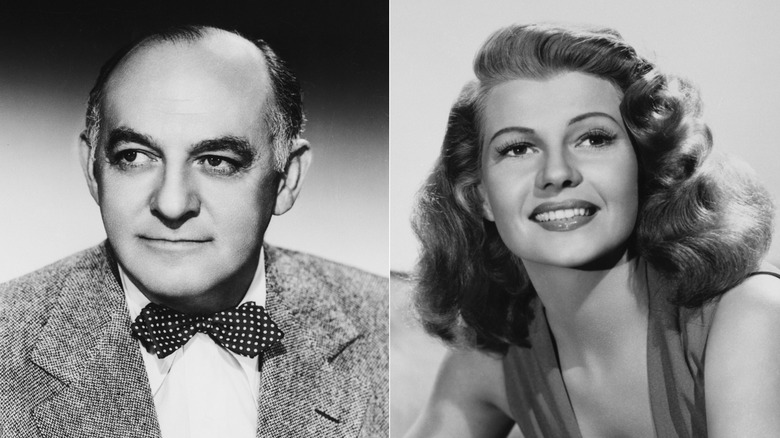
The name may not ring a bell for your average moviegoer in the 2020s, but Harry Cohn played a major role in shaping the golden age of Hollywood and the direction the movie business would take for years to come. Along with his brother, Jack, and Joe Brandt, Cohn founded CBC Film Sales Corporation, which became Columbia Pictures in 1924. And over the years that followed, he was one of Tinseltown's ultimate power brokers.
Said Cohn in 1946 (via the Golden Globes): "I may be known as a crude, loudmouth son-of-a-b***h, but I built Columbia. I started it with spit and wire and these fists. I stole, cheated, and beat people's brains out. Columbia is not just my love; it's my baby, my life. I'd die without Columbia." Cohn was allegedly one of the men responsible for entrenching the "casting couch" system, where young actresses would be pressured to sleep with execs for a chance at stardom. It was during this time that Cohn reportedly began to harass one of Hollywood's biggest stars, Rita Hayworth.
Per The Hollywood Reporter, Hayworth — who would one day regret her stage name — endured decades of advances from Cohn, who's credited with discovering the "Gilda" star. He reportedly resorted to bugging her dressing rooms and attempting to administer fines when she refused to fall in line. "In front of people, Harry Cohn would say, "I never put a hand on her,"" Hayworth told the New York Times in 1970 (via The Hollywood Reporter). "Of course he hadn't put a hand on me — as if I'd let him!"