

How The Scandalous History Of Studio 54 Rocked The 70s
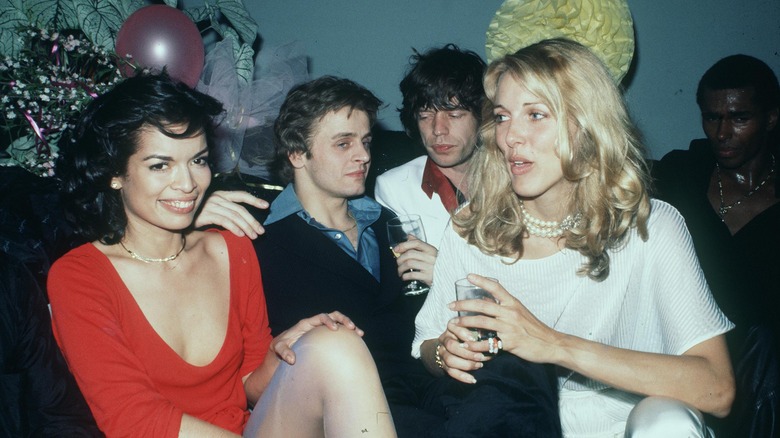
During the late 1970s, there was no cooler hotspot on Planet Earth than Studio 54, the Manhattan nightclub where the glitterati gathered to shake their booties to disco hits and ingest an absolutely insane amount of illicit drugs. It was a place where stockbrokers would rub shoulders with a disparate crowd ranging from drag queens to some of the world's biggest celebrities. And not just a few; on a typical night, it wouldn't be uncommon to see fashion designer Halston and his close friend Liza Minnelli dancing together while Truman Capote chatted up Mick and Bianca Jagger as the planet's hottest movie, TV, and music stars grooved to the beat. Meanwhile, pop art pioneer Andy Warhol voyeuristically took it all in, writing about what he'd witnessed in his now-notorious diaries when he returned home each night. "On any given evening, you'd have, you know, Rudolph Nureyev, you'd have Chuck Berry, Keith Richards," recalled doorman Bobby Sheridan when interviewed for The Cut.
Studio 54 was also the home of scandals a-plenty, from depraved celebrity shenanigans to the behind-the-scenes criminality of the club's owners, Steve Rubell and Ian Schrager, whose empire of decadence eventually crumbled to dust and marked the end of an era. It was a time of excess and extremes, and looking back, it's clear that the scandalous history of Studio 54 rocked the '70s.
Elizabeth Taylor partied with gay porn stars during her debauched birthday bash
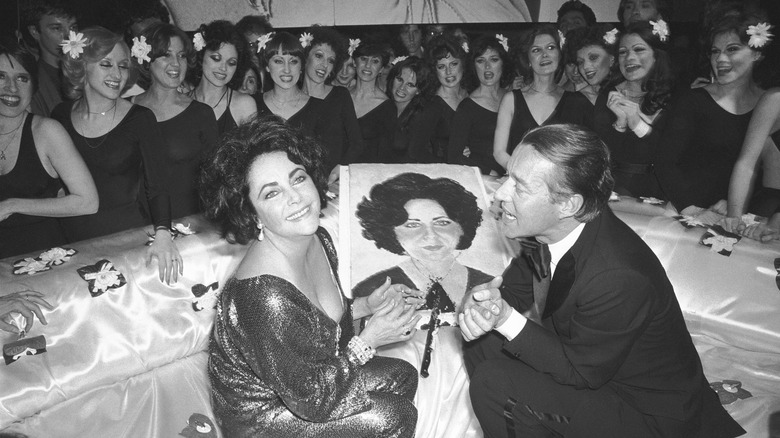
While a typical night at Studio 54 was over the top, the bar was raised whenever a party was held there. Such was the case when the club hosted a birthday party for movie icon Elizabeth Taylor. In addition to a birthday cake boasting a life-sized portrait of Taylor, the soiree also featured a performance by Radio Studio Music Hall staples The Rockettes.
Taylor and her then-husband, Senator John Warner, made a memorable entrance. "A dozen well-endowed hunks, naked but for sequined posing-pouches, and some with joints dangling from the corners of their mouths, scattered gardenia petals in the couple's path as they entered," wrote David Bret in his biography of Taylor, "The Lady, The Lover, The Legend." "The dancing and fun continued until the early hours, the atmosphere heavy with the stench of poppers and Elizabeth bebopping with a bevvy of gay porn stars, until Warner put his foot down and said that they were leaving."
Andy Warhol shared his far-from-flattering recollection of the guest of honor in a diary entry, posthumously published in "The Andy Warhol Diaries." "Liz looked like a — bellybutton," Warhol wrote of the birthday girl. "Like a fat little Kewpie doll."
The Studio 54 doorman determined who was allowed in
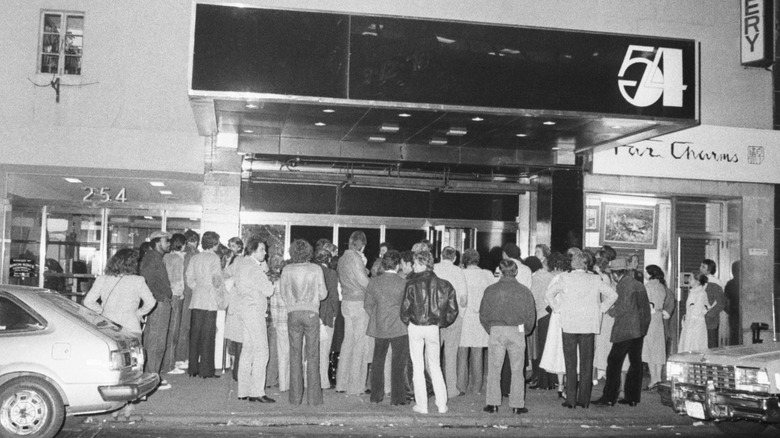
For the non-celebrities who waited outside in the slim hope that they'd be chosen to enter the glamorous world of Studio 54, whether or not that dream came true rested in the hands of two men: Marc Benecke and Bobby Sheridan, the club's doormen. They had the responsibility for ensuring the club had the right mix of partygoers, balancing out the celebs with quirky originals.
Interviewed for The Cut, Sheridan recalled the time that three well-to-do couples begged to be let in, annoyed when he turned down their attempts to bribe him with cash. While they argued with him, a regular named Rollerena — a roller-staking dude wearing a tiara — glided in, with occasionally shady rocker Rod Stewart strolling in behind him. "I said, 'Hi, Rod,' and he walked in," Sheridan remembered. "Those people just looked at me and turned and walked away."
During that time, dressing like John Travolta, one of the '70s biggest heartthrobs, in "Saturday Night Fever" was all the rage. However, if Sheridan saw anybody in that attire, they became an instant addition to his do-not-enter list. That came back to bite him when a guy with a shag haircut, bell-bottoms, and loads of gold chains walked up to the entrance — fitting all Sheridan's requirements to be ignored. "So this guy's standing out there for probably half an hour, [owner] Steve [Rubell] comes out and he looked at me and he said, 'I think that might be one of the Bee Gees,'" he continued. As it turned out, Rubell was correct. "I kept Barry Gibb waiting for half an hour," Sheridan recalled.
A wannabe got stuck in a vent and died trying to sneak into Studio 54

While celebrities were ushered right inside, gaining entrance to Studio 54 was no mean feat for the hoi polloi. Every once in a while, wannabes would attempt to circumvent the front door and seek other avenues of entrance.
For one would-be partygoer, this gambit proved to be a fatal one. "This guy got stuck in a vent trying to get in. It smelled like a cat had died. He was in black tie," Studio 54 party regular Baird Jones told author Anthony Haden-Guest for his book, "The Last Party."
In fact, Jones recalled others who used mountain-climbing equipment to break into the club's courtyard from an adjacent building. Those attempts became so pervasive that barbed wire was placed around the courtyard, which was intended to deter would-be party crashers — but only led to injuries. "They would tangle in the barbed wire and fall to the cement pavement which was 10 feet below," Jones added, remembering one guy who hurt himself so badly that he needed to be taken out on a stretcher. "And you could see him, trying to scope out the inside of the club. Trying to see it. Desperately!"
77-year-old Disco Sally danced the nights away, fueled by cocaine

One of Studio 54's regulars was diminutive 77-year-old Sally Lippman, who spent each evening at the club, dancing the night away. Grief-stricken after the recent death of her husband, Lippman coped by dancing the night away. Nicknamed Disco Sally, she quickly became a fixture at the club, shaking her septuagenarian booty like a woman decades younger. "She was a retired Jewish lawyer who became a judge and suddenly went crazy due to the combination of cocaine and the Studio 54 Effect," wrote author Mark Fleischman in his book, "Inside Studio 54" (via Vanity Fair). "But back in the day, she would dance nonstop — from midnight to 5:00 a.m. many nights a week, taking only bathroom and cocaine breaks."
Over time, Disco Sally became something of a celebrity in her own right, developing enough notoriety that she appeared on an episode of "The Lawrence Welk Show," teaching some disco moves to the polka-playing bandleader. In fact, it wasn't uncommon for the likes of Dustin Hoffman and Bill Murray to patiently wait in line for a turn to be her dance partner.
In 1980, Lippman married another Studio 54 regular, 28-year-old Johnny Touzos. Sadly, the marriage didn't last long; Lippman died just two years later, at the age of 82.
Studio 54's holiday parties were legendary for their debauchery
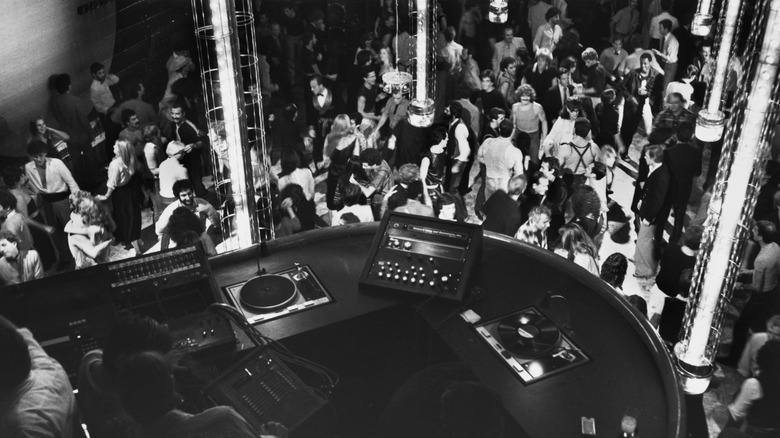
A lot of words have been used to describe Studio 54, but it's fair to say that "subtle" is not one of them. "It's like the end of the Roman Empire," a club-goer marveled to The New York Times in a 1978 profile celebrating the first anniversary of Studio 54. "It's like being inside a Fellini film," added another, while writer Truman Capote, a Studio 54 regular, declared, "It's the best floor show in town."
Studio 54 holiday celebrations were like nothing else in New York City, with Halloween a night when owners Steve Rubell and Ian Schrager pulled out all the stops. One Halloween, in fact, they spent $50,000 to transform the place into a haunted mansion, with actors dressed as monsters jumping out to scare guests. As time went on, they became increasingly creative in trying to top themselves. Recalling one night in particular, model Kevin Haley told Vanity Fair about a party in which little people were hired to act our various scenarios behind glass windows. "The one that sticks out in my head had a [little people] family eating a formal dinner," he recalled.
Not surprisingly, Christmas at Studio 54 wasn't nearly as wholesome as the celebrations taking place at the nearby Rockefeller Center ice rink. In fact, the phrase "let it snow" took on a whole different meaning when, during one Christmas celebration, celebrity guests received special holiday-themed party favors, consisting of baggies full of cocaine, tied up with a festive ribbon.
Bianca Jagger rode on horseback, and zebras partied on the dance floor
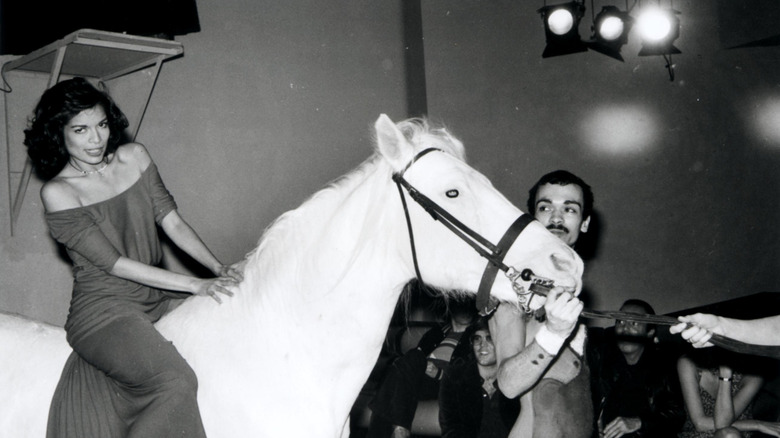
Among the most notorious nights in Studio 54 history was the evening of Bianca Jagger's birthday celebration. According to lore, the wife of Rolling Stones frontman Mick Jagger made an entrance fit for a royal, riding in atop a white stallion.
Or at least that's how it was remembered. The truth was somewhat different, albeit no less scandalous. What actually took place was that, around midnight, two naked attendants led the horse into the club, and Mrs. Jagger hopped atop it while the horse was led across the dance floor. She set the record straight in a letter to the Financial Times, addressing a story recalling how she came to be photographed on horseback. As Mick's ex-wife explained, club co-owner Ian Schrager had seen a photo of her riding a white horse in her native Nicaragua, and procured a similar steed as a surprise for the night of her party — and she briefly hopped on its back. "No doubt you will agree with me that it is one thing to, on the spur of the moment, get on a horse in a nightclub, but it is quite another to ride in on one," she wrote, declaring herself to be a staunch foe of animal cruelty, who would never do something as irresponsible as ride a horse into a midtown Manhattan nightclub.
Horses were not the only four-legged, hoofed creatures to party down in Studio 54. Once, Schrager brought live zebras into the club, which gave the phrase "dirty dancing" a whole new meaning. "The animals would take dumps on the dance floor," former Studio 54 manager Michael Overington told The Guardian.
Certain parts of Studio 54 were reserved for extra-hedonistic debauchery
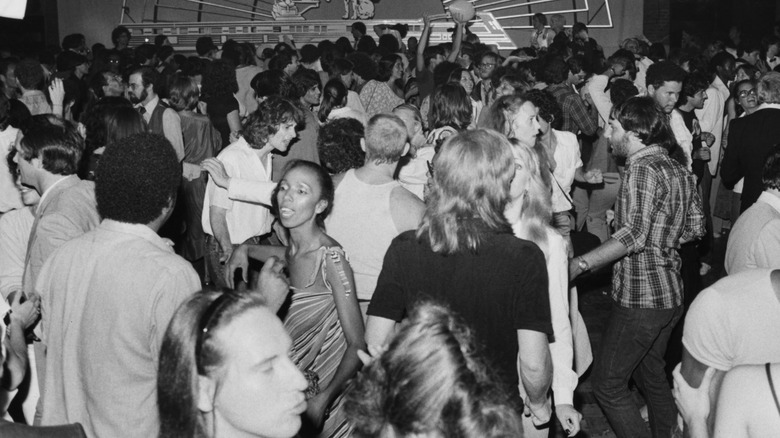
Beyond pooping zebras, the dance floor at Studio 54 was home to all manner of hedonistic behavior. Yet the dance floor was like Disneyland compared to what was taking place in more private areas of the club. Such was the case with the balcony, which had been upholstered in rubber to make cleaning up easier. "Up high in the seats above the stalls, you could disappear into the shadows and get up to whatever," wrote singer Grace Jones, a Studio 54 regular, in a passage from her memoir, "I'll Never Write My Memoirs."
Even more exclusive, however, was the club's infamous basement, reserved for only the most important of VIPs. "Celebrities headed for the basement. Getting high low-down," Jones wrote. With mattresses tucked into shadowy corners, the club's security personnel patrolled the area to keep the rabble out and protect the celebs' privacy. "The VIP room was called the Play Room," a former staffer recalled in a 1998 documentary, "The Rise and Fall of Studio 54." "And the Play Room is where select people would go to do drugs and hang out and get into sexual play."
As Jones wrote, there was nothing discreet about what was going on in these private zones of Studio 54. "You'd stumble into half-hidden rooms filled with a few people who seemed to be sweating because of something they had just done, or were about to do," she wrote.
Cocaine was the engine that drove Studio 54

The popularity of Studio 54 during the late 1970s came at a unique point in time, when the explosion of celebrity culture and disco dance music coincided with a massive influx of cocaine from South America. "It wasn't a barroom, it wasn't a discotheque, it was a cultural moment," former Studio 54 doorman Bobby Sheridan told The Cut.
Cocaine was the drug of choice, and Studio 54 made no secret of its importance to the club's social scene; famously hanging above the dance floor was a sculpture that epitomized the coke-fueled decadence. "There was a Man in the Moon that would come down and a coke spoon that would go up, and the tip of the moon's nose would light up," Sheridan recalled. "Cocaine was ubiquitous," he added, noting the drug was the one common element of the club's disparate clientele, from the celebrities, to the wealthy socialites, to the Wall Street guys, to the penniless club kids who gained entry because of their trendsetting looks. "Cocaine was the marijuana of the disco era," Sheridan observed.
Richard Bernstein, interviewed for the 1998 documentary "The Rise & Fall of Studio 54," recalled seeing a bunch of celebrities crammed into a private room one night, enjoying champagne while imbibing in a unique delicacy: strawberries dipped in cocaine. "It was amusing, and it was made up of some people you would know by name," he said, without naming names.
Dolly Parton was freaked out when farm animals were brought in for a party in her honor
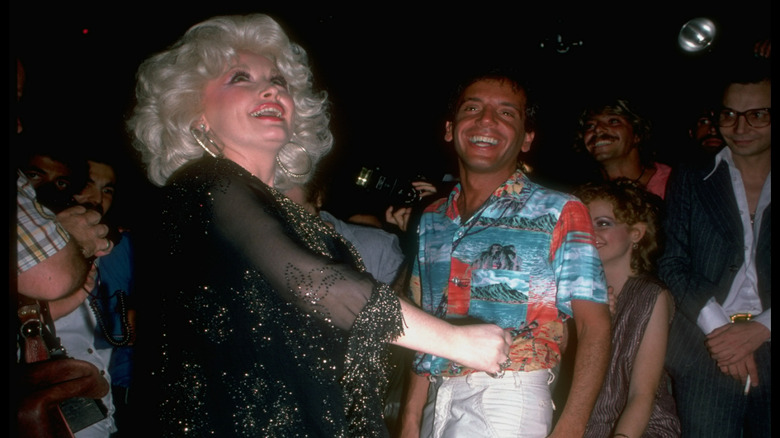
Among the things you didn't know about Dolly Parton was that she was once the guest of honor at a lavish party held at Studio 54. Co-owner Steve Rubell went all out for Parton, who was in New York for a series of concerts. Rubell decided a farm theme was in order, and enlisted Renny Reynolds — who orchestrated the club's elaborate parties — to bring in horses and other barnyard animals. "I had a farm wagon that we brought in and piled with hay. We had chickens in a pen," Reynolds told Anthony Haden-Guest for his book "The Last Party."
Tennessee-born Parton, however, did not have the reaction that her hosts expected. "Dolly came and was completely freaked out at the number of people there," Reynolds recalled, noting that the singer — a Studio 54 newbie at the time — wasn't prepared for the crowded and debauched scene she encountered. "She was real nervous about this whole deal and went up to the balcony and sat up there for a while," added Reynolds. "She was not a comfortable lady there."
Parton eventually became less hesitant toward Studio 54, and whenever she did drop by, she gravitated toward pop art guru (and Studio 54 regular) Andy Warhol. As she wrote in her memoir, "Behind the Seams: My Life in Rhinestones," they wound up bonding because both avoided drugs. "Andy and I would mostly just sit on the couch and watch all these crazy people out there doing their thing," Parton wrote (via Business Insider). "We really got to know each other, just sitting on that couch."
Studio 54's owners were raided by the IRS mid-party

Studio 54 owners Ian Schrager and Steve Rubell had a knack for publicity, and not all of it was good. That was the case when paparazzi photos of Margaret Trudeau (then wife of Canada's prime minister, Pierre Trudeau) partying at Studio 54 offered stark evidence she'd eschewed wearing underwear for the evening. Even worse was when President Jimmy Carter's chief of staff, Hamilton Jordan, had allegedly been spotted snorting cocaine while partying at Studio 54.
Meanwhile, it didn't help that the pair were operating with impunity; in a now-infamous interview with New York Magazine (via The New York Times), Rubell bragged they were making so much money that "only the mafia does better." Given all the scandals and Rubell's boasting, it was inevitable Studio 54 would land on the radar of the Internal Revenue Service. In December 1978, during a typically bacchanalian night of Studio 54 debauchery, IRS agents raided the club. Schrager tried to sneak off with financial records, but was spotted by agents before making it out the door. When they examined the material he was attempting to remove, agents found a large envelope containing several baggies full of cocaine.
That led to not only drug charges filed against Schrager, but also a massive IRS investigation into the club's finances. The IRS eventually determined the pair had skimmed about $2.5 million worth of unreported income; in 1979, they were arrested and indicted on a laundry list of charges, including tax evasion, conspiracy, and obstruction of justice.
The party ended when owners Steve Rubell and Ian Schragerwent to prison for tax evasion
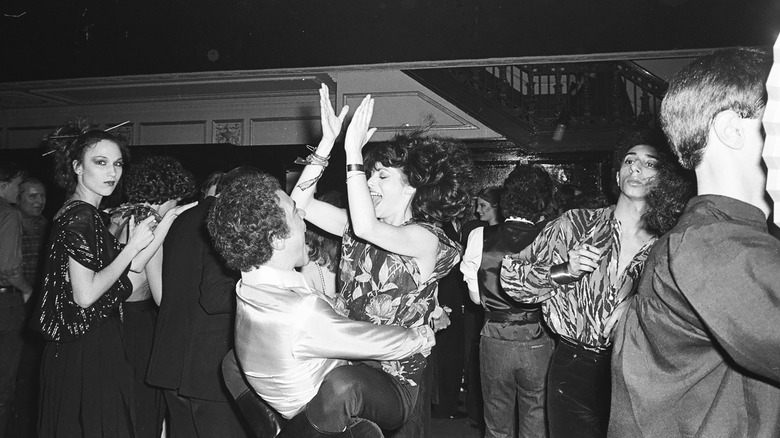
Represented by controversial lawyer Roy Cohn, who also represented Donald Trump, Studio 54 owners Ian Schrager and Steve Rubell pled guilty to tax evasion. On January 18, 1980, they were sentenced to serve three-and-a-half years in prison. Before surrendering to authorities and shutting down Studio 54, they decided to hold one final party. Titled "The End of Modern-Day Gomorrah," a bevy of celebs turned out to say goodbye to the hottest nightclub of the 1970s. Diana Ross sang to the 2,000 or so assembled guests, a roster that included Richard Gere, comedian David Brenner, and Studio 54 regulars Andy Warhol and Liza Minnelli. Rubell entertained his guests by donning a Frank Sinatra-style fedora and crooning "My Way."
The party lasted until the wee hours of the morning, when the crowd eventually thinned out. Among the last to leave was New York Post columnist Jack Martin, who recalled hanging out with Rubell during his final hours of freedom. "Steve was sort of alone," Martin said (via "The Last Party"). "He was sort of spaced-out. He had accepted it. ... We were with him literally until he took a car to go home and meet the authorities."
And that was it. Studio 54 subsequently reopened in 1981 under new management, but it was never the same, closing its doors for good in 1986. Looking back on those halcyon years, Schrager told Women's Wear Daily, "We were two guys from Brooklyn trying to hold onto a lightning bolt and to create the best crowd we could to make everybody have a good time."